
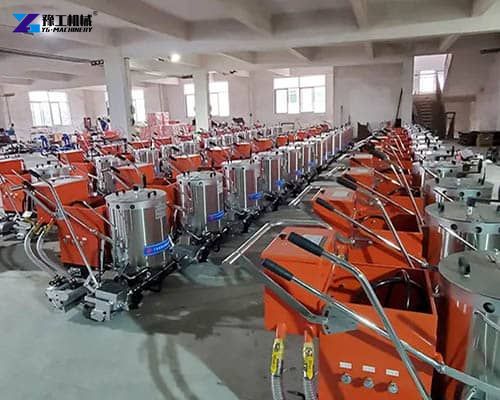
Thermoplastic road marking paint machine is essential equipment for those who need clear, durable, and consistent pavement markings. Designed for hot-melt road marking applications, this equipment applies molten thermoplastic material to prepared road surfaces to create traffic lines, parking space markings, directional indicators, and other pavement markings. For road construction companies, municipal maintenance departments, parking facility operators, and traffic engineering contractors, choosing the right road marking equipment can improve line consistency, simplify daily operations, and support efficient project management. The YG-360S and YG-380S electric thermoplastic road marking machines are designed for professional line marking work. Both models feature insulated stainless steel tanks, adjustable marking widths, synchronized glass bead spreading, and battery-powered travel. Their practical configurations make them suitable for a range of road marking projects where accuracy and operating flexibility are important.
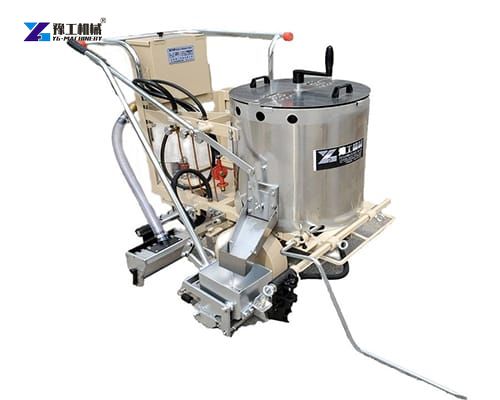
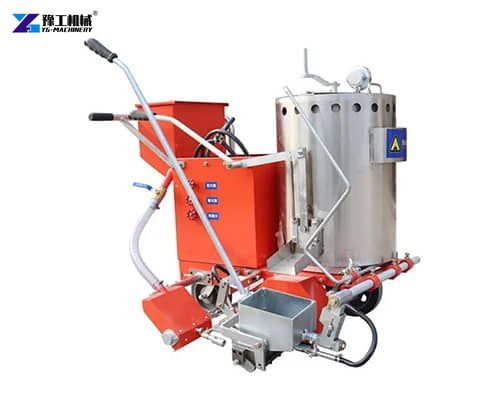
Specifications of the Thermoplastic Road Marking Paint Machine
| Model | YG-360S | YG-380S |
| Thermoplastic Tank | 100kg, double stainless steel heating insulation barrels, plug-in manually mixer devices,removable devices | 100kg, double stainless steel heating insulation barrels, plug-in manually mixer devices,removable devices |
| Glass Bead Container | 10kg/box | 10kg/box |
| Adjustable glass bead spreader | synchronous clutch spreading, equipped with speed-adjustable gear shifting device, single/double spreading can be selected according to needs 50-200mm | synchronous clutch spreading, equipped with speed-adjustable gear shifting device, single/double spreading can be selected according to needs 50-200mm |
| Rear Wheel Directional Device | Ensure the machine moving in straight line or tuning freely in curved road | Ensure the machine moving in straight line or tuning freely in curved road |
| Brake | Using drum brake, you can adjust the brake tension | Using drum brake, you can adjust the brake tension |
| Marking width | Standard 150mm marking bucket 100mm、150mm、200mm、250mm、300mm、400mm、450mm (at customers’ option) |
Standard 150mm marking bucket 100mm、150mm、200mm、250mm、300mm、400mm、450mm (at customers’ option) |
| Battery Capacity | 15AH | 15AH |
| Battery Voltage | 48V lithium battery | 48V lithium battery |
| Driver Speed | 1-8km/hour | 1-8km/hour |
| Working Duration | Machine can mark road lines24 hours after charging battery5 hours | Machine can mark road lines24 hours after charging battery5 hours |
| Dimensions | 1210X970X1070mm | 1200X970X1100mm |
| Net weight | 130kg | 150kg |
Designed for Efficient Hot-Melt Road Marking
Different from cold paint striping equipment, the thermoplastic road marking paint machine works with thermoplastic material that has been heated and melted before application. The molten material is transferred to the marking unit, which forms lines on the pavement according to the selected marking width.
The YG-360S and YG-380S are designed to help operators produce neat, consistent road markings while maintaining control over machine movement and bead application. Their insulated tanks help retain material heat during marking operations, while the adjustable travel system supports controlled movement across different working areas.
These machines can be used with a suitable thermoplastic preheater or hot-melt kettle. The heating and material preparation process should follow the coating manufacturer’s instructions to achieve the required application temperature and marking quality.
For contractors looking for a thermoplastic road marking machine that combines practical operation with flexible line-width options, these two models provide a useful starting point for comparing equipment configurations.
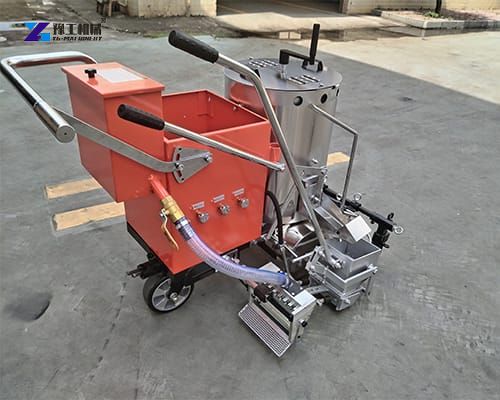
Features of Thermoplastic Road Marking Paint Machine
Our machines are built with the latest technology to deliver superior performance on every job. We offer models such as the YG-360S and YG-380S, both featuring a 100kg capacity double stainless steel heating insulation barrel, ensuring the paint stays at the optimal temperature for extended periods. The inclusion of an adjustable glass bead spreader equipped with a synchronous clutch allows for precise control, enabling single or double spreading according to your specific project needs.
Operational flexibility is at the core of our design. The machines are equipped with a rear wheel directional device, ensuring the equipment moves in a straight line or turns freely in curved road scenarios. For precise applications, the machine features a standard 150mm marking bucket with multiple optional widths ranging from 100mm to 450mm. Powering these machines is a robust 48V lithium battery, providing a steady working duration of 24 hours after charging. With a driver speed ranging from 1 to 8 kilometers per hour and the capability to mark lines for up to 24 hours after charging, these machines are built for endurance and heavy-duty daily use.
Where to Apply the Thermoplastic Road Line Marking Equipment?
The versatility of this thermoplastic road marking paint machine makes it suitable for a wide array of environments.
It is ideal for highway construction and maintenance, where long, continuous, and highly reflective lines are mandatory for high-speed traffic safety.
City municipalities use it for crosswalks, stop lines, and lane dividers, where precision and rapid drying times are essential to minimize traffic disruption.
Furthermore, it is perfect for marking vast parking lots, airport runways, and factory floors.
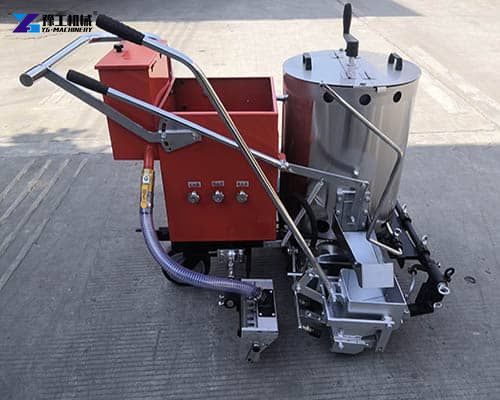
Core Advantages of Choosing Our Thermoplastic Road Striping Machine
Choosing our machine gives your business a competitive edge.
The primary advantage is the significant increase in operational efficiency; the manual mixing devices and synchronous spreading systems drastically reduce manual labor and application time.
The durable construction, featuring double stainless steel insulation, means less material waste and lower operational costs over time.
Additionally, the safety features, such as the drum brake for adjusting tension, ensure that operators can work confidently even on uneven terrain.
The adjustability of the marking width allows for incredible project versatility without the need to switch machines, saving you both time and capital expenditure.
How to Choose the Right Thermoplastic Road Marking Machine?
Before purchasing, buyers should identify the types of projects they expect to handle. Highway markings, municipal roads, parking facilities, and industrial yards can have different requirements for marking width, material consumption, reflective performance, and daily workload.
The first consideration is marking width. Confirm the line dimensions required by your projects and check whether the corresponding marking bucket is included in the machine configuration.
The second consideration is material preparation. The thermoplastic road marking paint machine requires appropriately melted material. Buyers should confirm whether a hot-melt kettle or preheater is needed and whether that equipment is included in the quotation.
The third consideration is battery operation. Check the battery specifications, charging time, expected operating duration, and the availability of replacement batteries or service components.
The fourth consideration is site handling. Compare the overall dimensions and net weight of the two models against your transport vehicle, storage area, and working environment.
The fifth consideration is after-sales support. Ask the supplier about operator instructions, spare parts, technical assistance, packaging, and delivery arrangements.
Operating Recommendations for Better Marking Results
Good road marking results depend on more than the machine itself. The pavement must be suitable for the selected thermoplastic material, and loose dust, dirt, moisture, oil, and other contaminants should be removed as required by the project specifications.
Thermoplastic material should be heated and mixed according to the manufacturer’s instructions. Overheating or insufficient heating can affect material properties and application quality, so operators should follow the recommended temperature range for the specific coating.
Before starting a full project, it is advisable to conduct a trial marking to check line width, edge definition, material flow, and glass bead application. Operators can then adjust the machine settings and working pace as necessary.
Regular cleaning and inspection are also important. Marking components, spreading mechanisms, wheels, directional devices, brakes, and battery connections should be checked as part of routine maintenance. Proper care can help reduce avoidable downtime and maintain consistent equipment performance.